
A Practical Guide to FMLA vs. Short Term Disability

FMLA and Short-Term Disability: Job Protection vs. Pay
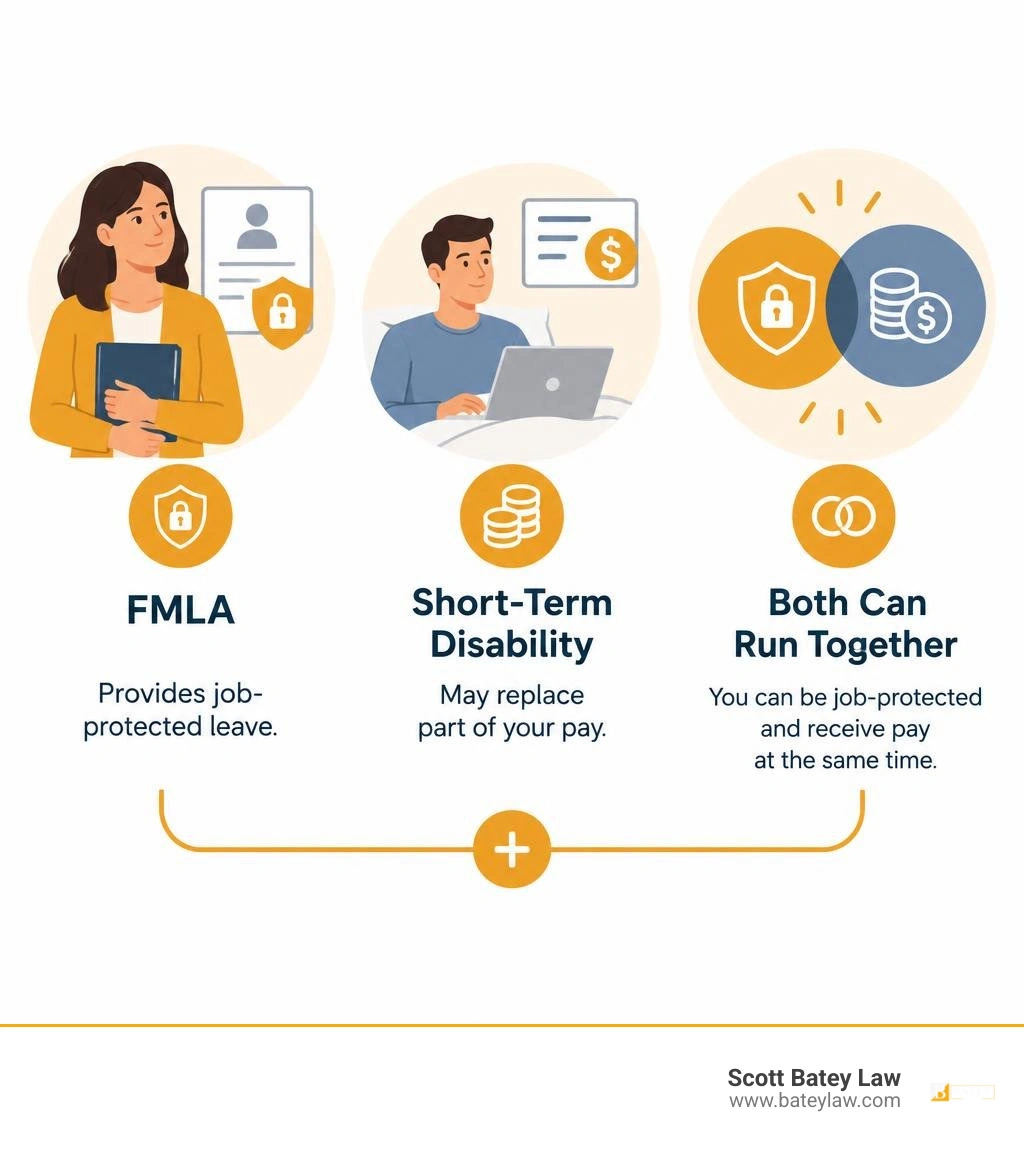
FMLA and short-term disability do different jobs. For eligible workers, the Family and Medical Leave Act (FMLA) provides unpaid, job-protected leave and continued group health coverage. Short-term disability may replace part of your pay while you cannot work because of your own medical condition, but it does not protect your job on its own. If you qualify for both, they can run at the same time.
That difference matters when you plan leave or face pressure to return before you are ready. Your short-term disability payments may continue after FMLA protection ends, so it is worth checking whether other workplace protections apply.
I’m Scott Batey, a Michigan employment lawyer with nearly three decades of experience representing workers in FMLA disputes and disability accommodation cases. I help employees understand how FMLA and short term disability affect their rights at work.
Understanding FMLA and Short Term Disability: Core Differences
When an unexpected illness or medical emergency strikes, navigating time off work can quickly feel overwhelming. Many workers assume that getting approved for short-term disability (STD) automatically means their job is safe, or conversely, that taking family and medical leave means a paycheck will keep coming. In reality, these two programs serve entirely distinct functions.
The Family and Medical Leave Act is a federal labor law enforced by the U.S. Department of Labor (DOL). Its primary purpose is statutory job security and benefit preservation. Short-term disability, on the other hand, is an insurance product designed solely for partial income replacement. Understanding how fmla and short term disability differ is the first step toward safeguarding both your health and your livelihood.
| Feature | Family and Medical Leave Act (FMLA) | Short-Term Disability (STD) |
|---|---|---|
| Primary Purpose | Legal job protection and health insurance maintenance | Partial income and wage replacement |
| Compensation | Unpaid | Typically 40% to 70% of pre-disability earnings |
| Governing Authority | Federal statutory law (U.S. Department of Labor) | Private insurance contracts or employer benefit plans |
| Duration | Up to 12 workweeks per 12-month period (26 for military caregiver) | Typically 9 to 26 weeks (varies by policy) |
| Job Reinstatement | Guaranteed right to the same or an equivalent position | No inherent job protection under federal law |
| Health Insurance | Employer must maintain existing group coverage terms | Not mandated by policy (governed by employer leave rules) |
| Caregiving Coverage | Yes (covers self, child, spouse, or parent) | No (strictly covers the employee's own condition) |
Eligibility Criteria for Statutory Leave and Wage Replacement
Qualifying for federal leave does not automatically mean you qualify for insurance benefits, and vice versa. Each system applies its own distinct set of rules.
To qualify for statutory leave under the FMLA, an employee must meet three specific federal criteria:
- Must have worked for a covered employer for at least 12 months (which need not be consecutive).
- Must have logged at least 1,250 hours of service during the 12-month period immediately preceding the leave.
- Must work at a location where the employer maintains at least 50 employees within a 75-mile radius.
Short-term disability insurance criteria are established by private insurance policy terms rather than federal statutes. While standard policies often cover non-work-related illnesses and injuries, they usually impose:
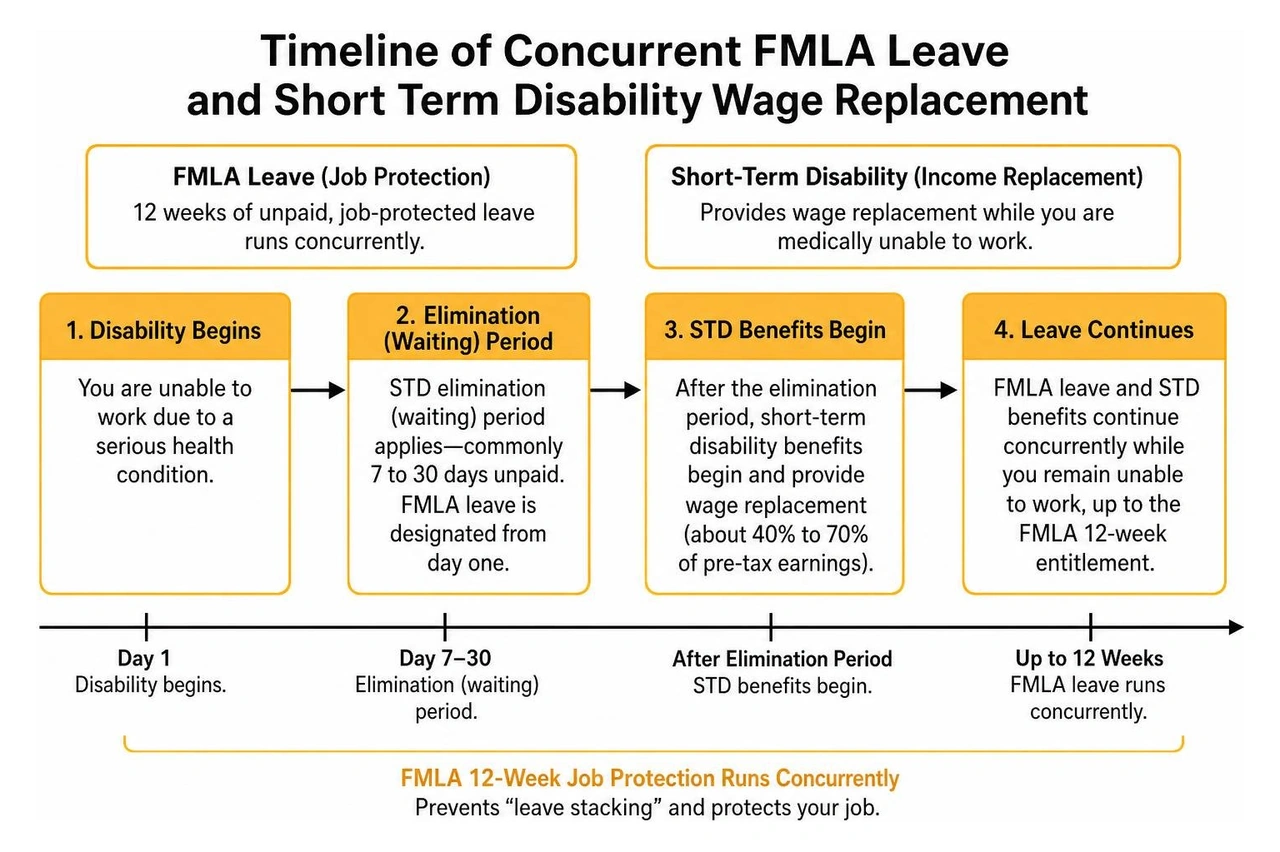
- Elimination (Waiting) Periods: A mandatory unpaid gap—commonly lasting between 7 and 30 days—between the date of disability and the start of benefit payouts.
- Pre-Existing Condition Clauses: Exclusions or waiting windows for conditions diagnosed or treated shortly before coverage began.
- Strict Medical Proof Requirements: Claims adjusters evaluate functional limitations and clinical evidence before approving wage payouts, which makes careful FMLA paperwork compliance and thorough medical certification vital.
Mandatory vs. Voluntary Employer Obligations
Under federal law, private employers with 50 or more workers and all public sector entities must comply with FMLA regulations. However, federal law does not require private employers to provide or fund short-term disability insurance for their staff.
Only a handful of jurisdictions (California, Hawaii, New Jersey, New York, Rhode Island, and Puerto Rico) require statutory temporary disability insurance. In Michigan, private employers are under no statutory mandate to offer private STD plans. If an employer in Detroit, Southfield, or Birmingham chooses to provide short-term disability coverage, it is offered as a voluntary fringe benefit governed by contract terms, ERISA regulations, and baseline Michigan family medical leave standards.
How FMLA and Short-Term Disability Work Concurrently

A frequent question employees ask is whether these two programs can operate at the exact same time. The answer is yes. In fact, running them concurrently is standard practice across most workplaces.
When you take leave for your own serious health condition, your employer will typically designate your time away as FMLA leave while you file a simultaneous claim for short-term disability wage benefits. This setup ensures that your statutory 12-week job protection clock ticks alongside the income replacement provided by your policy, preventing "leave stacking" (taking 12 weeks of unpaid leave followed consecutively by another 12 to 26 weeks of disability leave).
Properly coordinating disability benefits and medical leave ensures workers maintain cash flow without jeopardizing their employment status.
Can You Receive FMLA and Short Term Disability at the Same Time?
Receiving short-term disability benefits while on FMLA leave is not only permitted, it is the most common way employees avoid financial hardship during medical time off. Because FMLA is strictly unpaid under federal law, disability benefits bridge the financial gap by replacing roughly 40% to 70% of regular pre-tax earnings.
Crucially, because short-term disability payments are considered a form of wage replacement, employers generally cannot force an employee to deplete their accrued paid time off (such as sick leave or vacation days) while disability benefits are active, unless permitted by written policy.
It is also important to note how leave structures differ. While the FMLA allows employees to take intermittent leave (such as taking half-days or single days off for chronic conditions), most short-term disability policies require a continuous, unbroken period of absence to pay out benefits. Understanding these boundaries is critical for protecting against FMLA interference when employers mismanage overlapping leave designations.
Medical Conditions That Qualify for Both FMLA and Short-Term Disability
To qualify for both programs concurrently, your medical circumstance must satisfy both the FMLA definition of a "serious health condition" and the insurance carrier's definition of "total or partial temporary disability."
Under Department of Labor Fact Sheet 28P health condition definitions, a serious health condition involves inpatient care (an overnight stay in a hospital or hospice) or continuing treatment by a healthcare provider. Common conditions qualifying for both programs include:
- Surgical Procedures and Inpatient Care: Inpatient or major outpatient surgeries involving general anesthesia, hospital admission, and extensive post-operative healing periods.
- Pregnancy and Childbirth Recovery: Postpartum physical incapacitation following vaginal birth (typically 6 weeks) or cesarean section (typically 8 weeks).
- Autoimmune and Chronic Illnesses: Severe flare-ups related to conditions like Lupus, Multiple Sclerosis, or Crohn’s Disease, making short-term disability for autoimmune disease a common path for extended treatment.
- Severe Mental Health Conditions: Major clinical depression, severe anxiety disorders, or PTSD requiring intensive outpatient therapy, psychiatric stabilization, or inpatient care.
- Severe Non-Work-Related Injuries: Broken bones, torn ligaments, or motor vehicle accident injuries that restrict essential job functions.
What Happens When FMLA Runs Out but Disability Benefits Continue?

One of the most precarious moments for any employee occurs when their 12 weeks of statutory FMLA leave expires, but their medical recovery requires an additional month or two of rest. Because many short-term disability policies provide income replacement for up to 26 weeks, employees often find themselves receiving disability checks while having zero remaining FMLA protection.
Once FMLA ends, the employer is no longer bound by statutory FMLA job-reinstatement obligations. However, that does not give management an automatic green light to fire you. Under federal and state employment laws governing medical and disability leave, workers remain shielded by critical anti-discrimination statutes. Recognizing these boundaries helps employees avoid evaluating red flags after medical leave when HR sends premature termination notices.
ADA and PWDCRA Protections for Extended Medical Leave
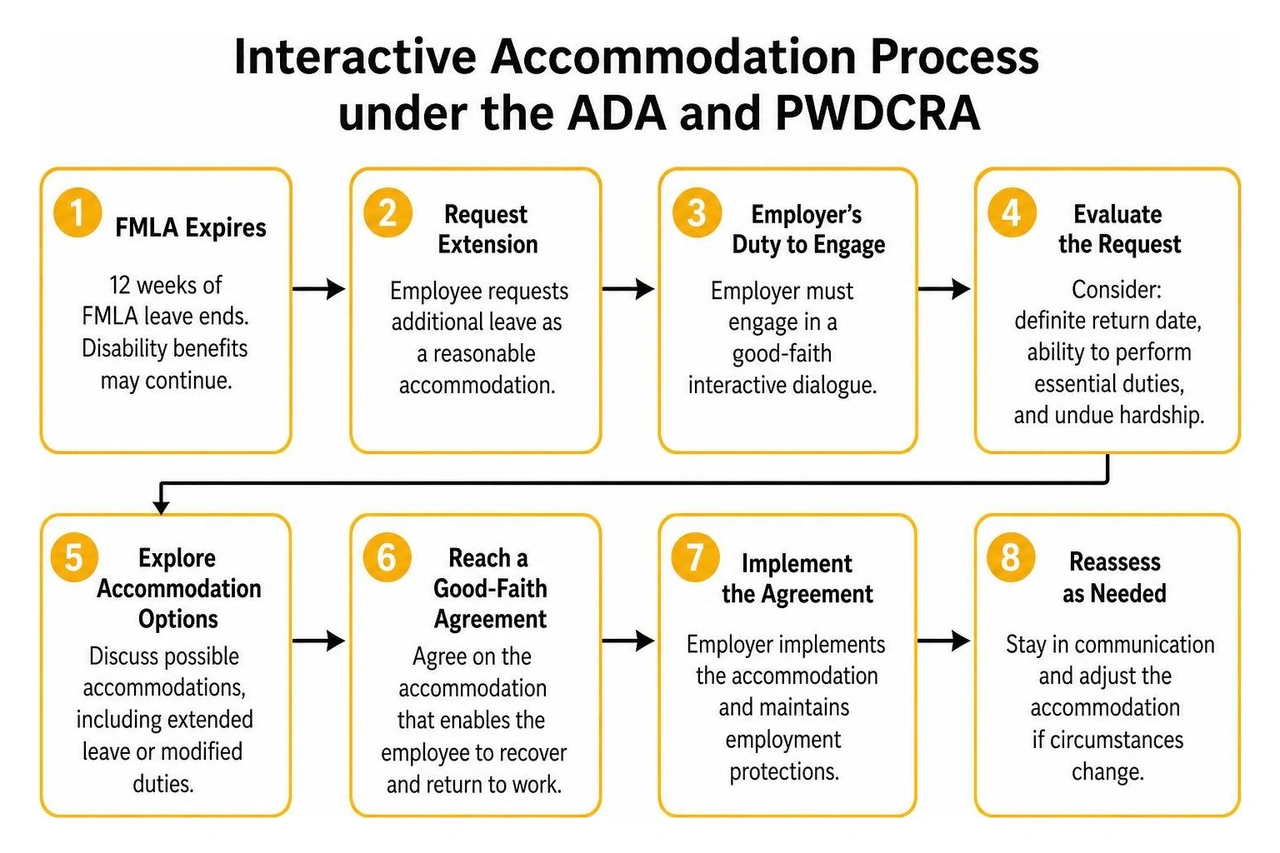
When FMLA expires, two primary disability statutes step in to protect workers: Title I of the Americans with Disabilities Act (ADA) and Michigan’s Persons with Disabilities Civil Rights Act (PWDCRA).
Under both statutes, an extended medical leave of absence can constitute a reasonable accommodation, provided that:
- The extension has a definite or reasonably estimated return date (not an indefinite leave).
- The extra time off allows the employee to recover and resume essential job duties.
- The leave extension does not create an undue hardship (significant operational difficulty or prohibitive financial expense) for the employer.
Employers are legally obligated to engage in a good-faith interactive dialogue before issuing any adverse employment decisions. They cannot simply terminate an employee on day 85 of an absence because the 12-week FMLA window closed. Employees in Oakland County and across southeast Michigan can assert their reasonable accommodation rights in Michigan to protect their employment status while concluding medical care.
The 100% Healed Rule and Workplace Return Rights
A recurring compliance failure occurs when employers demand that an employee be "100% healed" or have zero medical restrictions before allowing them to return to the job.
Federal courts and state civil rights agencies have repeatedly struck down blanket "100% healed" rules as unlawful disability discrimination. Management cannot refuse to reinstate you simply because your physician noted lifting limits, schedule adjustments, or regular rest breaks.
Subjecting workers to the 100% healed policy myth violates basic accommodation principles. When preparing to return to work, having clear light duty return to work notes outlining your specific capabilities forces employers to evaluate modified duty options in good faith.
Medical Documentation and Filing Procedures
Securing both statutory leave and insurance benefits requires strict adherence to administrative deadlines and medical documentation standards. Overlooking a single form can result in denied wage claims or unexcused attendance infractions.
To protect your legal rights, follow these key documentation steps:
- Provide Timely Notice: When leave is foreseeable (such as scheduled surgery or childbirth), give your employer at least 30 days' advance notice. If the medical emergency is sudden, provide notice as soon as practicable.
- Complete DOL Certification Forms: Employers usually require Department of Labor Form WH-380-E (for your own health condition) or WH-380-F (to care for a family member). Once HR issues the form, you have 15 calendar days to return the completed paperwork from your physician.
- Submit Separate Insurance Paperwork: Your HR department handles FMLA, but an outside insurance carrier or third-party administrator (TPA) typically adjudicates short-term disability. You must submit an Attending Physician Statement (APS) and an employee statement directly to the carrier.
- Protect Confidentiality: FMLA certifications require clinical information demonstrating a serious condition and functional restrictions, but they do not require an explicit medical diagnosis.
- Monitor Attendance Points: Under federal law, absences protected by the FMLA cannot be counted against an employee under no-fault or progressive disciplinary policies. Be mindful of attendance point systems vs FMLA rights if management attempts to penalize certified medical absences.
Frequently Asked Questions About FMLA and Short-Term Disability
Can my employer force me to use accrued PTO while on short-term disability?
Generally, no. Under standard FMLA regulations, employers can mandate that workers substitute accrued paid leave (vacation, personal, or sick days) during an otherwise unpaid FMLA absence. However, when an employee is receiving disability wage replacement benefits through a short-term disability policy, the leave is no longer considered "unpaid."
Consequently, neither the employer nor the employee can force the substitution of paid time off during active disability pay periods. Some employers may allow workers to use partial PTO hours to "top off" disability checks from 60% to 100% of their base salary, but this practice depends on specific company handbook policies.
Does short-term disability cover maternity and parental bonding leave?
Short-term disability policies only cover the physical medical disability associated with pregnancy, childbirth, and postpartum recovery. For typical uncomplicated deliveries, insurers generally approve 6 weeks of wage replacement for vaginal births and 8 weeks for cesarean sections.
Once that postpartum physical recovery window ends, short-term disability benefits terminate. Non-birthing parents and adoptive parents cannot receive STD benefits for bonding. However, all eligible parents—regardless of gender—are entitled to use up to the full 12 weeks of job-protected, unpaid FMLA leave to bond with a newborn or newly placed adoptive child within the first 12 months following birth or placement.
Can an employee be fired while receiving short-term disability benefits?
Yes, because short-term disability is purely an income-protection insurance benefit and provides zero legal job security on its own. If your 12-week FMLA window has expired, or if you were not eligible for FMLA coverage when your leave began, your job is not preserved by the disability carrier.
However, an employer cannot terminate an employee simply because they applied for benefits or developed a disability. Discharging a worker due to their medical condition, refusing reasonable leave extensions without showing undue hardship, or punishing an employee for taking statutory time off constitutes unlawful discrimination. Workers should stay vigilant for recognizing FMLA retaliation red flags if termination occurs during or immediately following medical leave.
Conclusion
Managing a serious health condition is stressful enough without the added anxiety of navigating confusing leave rules and insurance forms. While the Family and Medical Leave Act protects your job and medical benefits for up to 12 weeks, short-term disability serves as a critical financial bridge to replace lost income. Running them concurrently provides the strongest protection available under employment law.
When leave runs past the 12-week mark, your legal protections shift from statutory FMLA rules to disability accommodation rights under the ADA and Michigan’s PWDCRA. If your employer refuses reasonable accommodations, demands an unlawful 100% healed release, or retaliates against you for taking necessary medical time away, you have legal options.
At Scott Batey Law in Bingham Farms, Michigan, we have dedicated over 25 years to fighting for employee rights across Oakland County, Southfield, Troy, Birmingham, and metro Detroit. If you are struggling with medical leave disputes, review our guide on managing short-term disability after FMLA runs out or contact our team today to evaluate your case and protect your career.