.png)
The Ins and Outs of Non-Compete Agreements

Non-Compete Agreements: What They Mean for Your Next Job
A non-compete agreement is a contract that limits where or how you can compete with a former employer after your job ends. Employers use these agreements to protect business interests, such as trade secrets and customer relationships. But signing one does not automatically make it enforceable. In Michigan, a restriction must be reasonable in its length, geographic reach, and the work it prevents you from doing.
If you are leaving a job, read the agreement before turning down a new opportunity or assuming you cannot take it. The details matter.
I'm Scott Batey, a Michigan employment lawyer who has represented workers since 1996 and advises employees on the terms of a non compete agreement. Here is what to look for and how those terms may affect your next move.
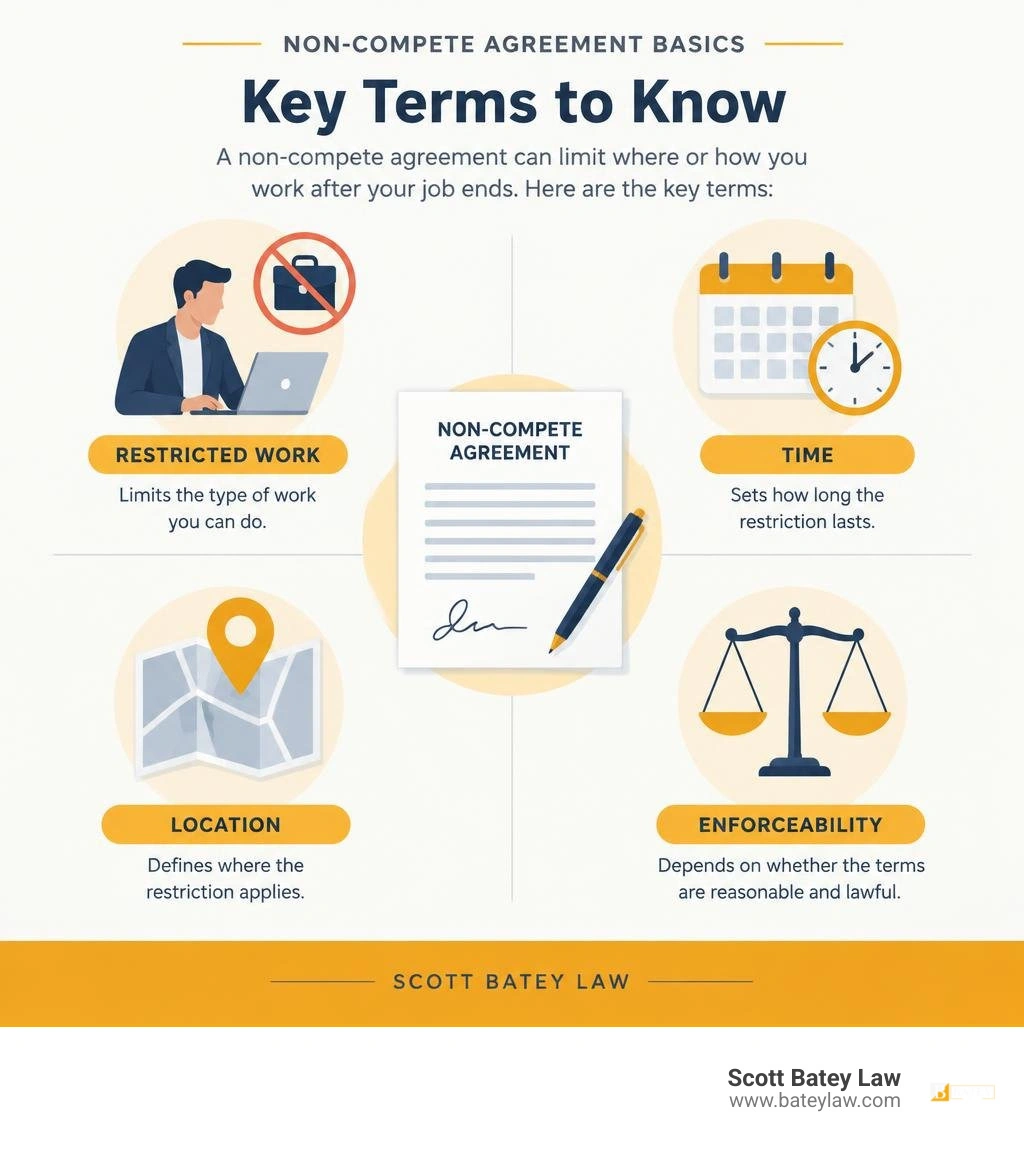
Key terms for non compete agreement:
What Is a Non-Compete Agreement and How Does It Work?
At its core, a covenant restricting competition is an agreement where a worker pledges not to enter into competition of a similar nature, either by establishing a rival business or accepting employment with a direct competitor, for a specified period after separation.
Employers rely on these restrictive covenants to protect legitimate business interests. These interests typically fall into distinct categories:
- Guarding genuine trade secrets and proprietary formulas.
- Shielding confidential methodologies and client database analytics.
- Protecting the investment made in establishing customer goodwill.
However, the law recognizes an important balance. A restrictive covenant cannot simply exist to stifle competition or lock employees into their jobs. To understand how these restrictions fit within a standard contract package, it is helpful to look at how they compare to related clauses.
Understanding the differences between non-compete and non-solicitation clauses is critical when evaluating any separation package.
| Restrictive Covenant Type | Primary Objective | Typical Scope & Focus | Enforceability Threshold |
|---|---|---|---|
| Non-Compete Agreement | Prohibits performing similar work for direct rivals or launching a competing business | General industry segment within a specific geographic territory | Subject to strict reasonableness tests regarding duration, geography, and scope |
| Non-Solicitation Agreement | Prevents contacting past clients or recruiting former co-workers | Specific client lists, prospective accounts, and company staff | Broadly enforced when tailored to accounts the employee actually managed |
| Non-Disclosure Agreement (NDA) | Prevents unauthorized use or sharing of proprietary company information | Defined confidential data, trade secrets, software code, and pricing strategies | Highly enforceable indefinitely or for a defined duration, provided the data remains private |
Key Clauses in a Standard Non-Compete Agreement
When reviewing the terms of a contract, several foundational clauses determine its practical scope:
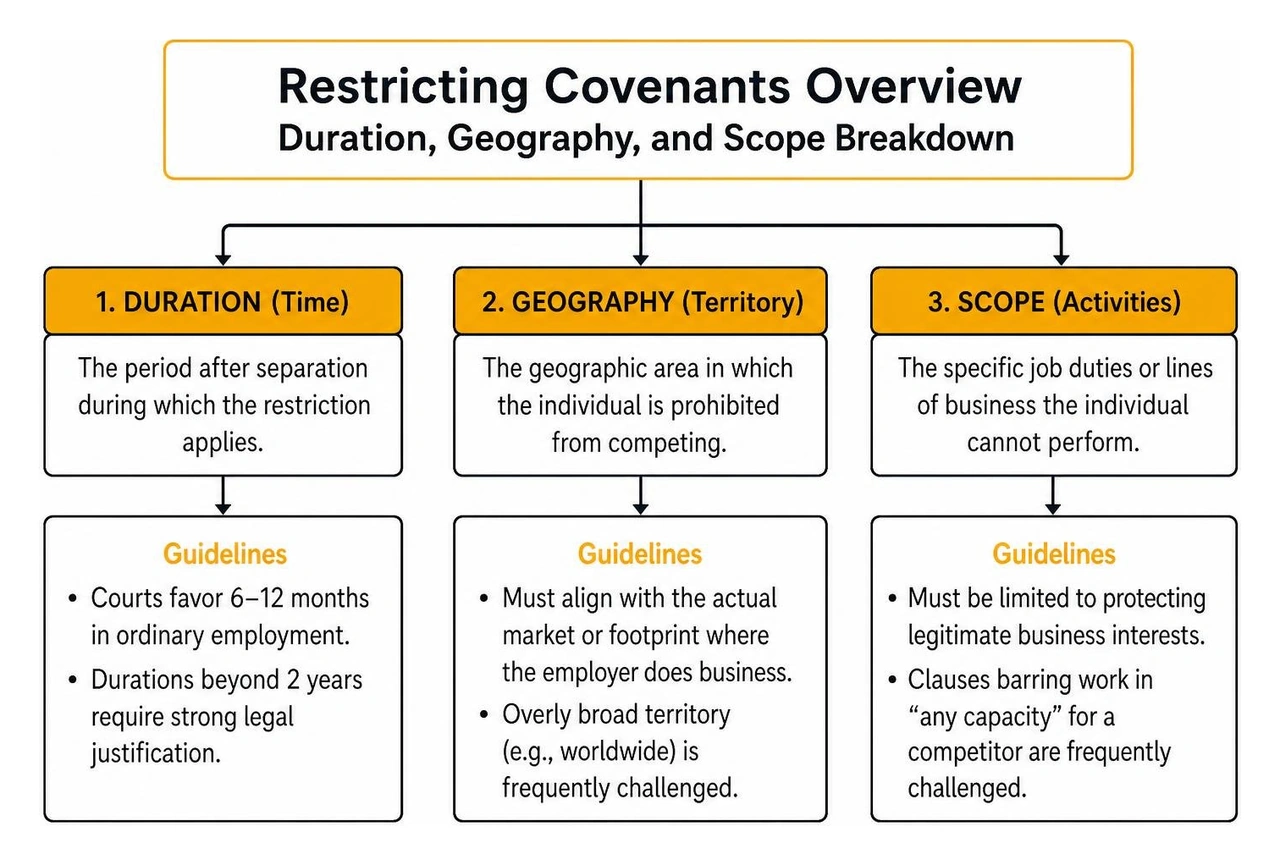
- The Restricted Period: The operational timeframe for the restriction. In ordinary employment contexts, courts routinely favor intervals between six months and one year, while durations spanning beyond two years demand strong legal justification.
- Geographic Scope: The defined territory in which you are prohibited from competing. This should strictly align with the actual market or footprint where the employer conducts business, rather than an arbitrary worldwide ban.
- Prohibited Activities: The specific job duties or lines of business you cannot perform. Clauses barring an individual from working in "any capacity" for a competitor are frequently challenged.
- Consideration Requirement: The legal value provided to the worker in exchange for signing. While an offer of initial employment often suffices for incoming hires, mid-employment covenants often require distinct consideration, such as a promotion or cash bonus.
- Passive Investment Exceptions: Standard drafting often permits workers to hold minor equity stakes (such as owning up to 2% to 5% of shares) in publicly traded rival entities without triggering a breach.
For workers evaluating contracts across various jurisdictions, standard forms and provisions can be reviewed using multi-state non-compete agreement resources to see how covenants differ across state lines.
Distinguishing Restrictive Covenants and Confidentiality Terms
Employers often package non-competes alongside confidentiality agreements and customer non-solicitation covenants. A non-disclosure agreement prevents you from leaking or using internal trade secrets, client pricing, and technical blueprints. Non-solicitation terms focus on preventing you from actively encouraging company clients to switch their accounts or recruiting former colleagues to join a new venture.
Problems often arise during workforce transitions when restrictive terms are tucked inside exit paperwork. When presented with separation documentation, workers should carefully identify severance agreement restrictions that quietly introduce new competitive restraints under the guise of standard release language.
Enforceability Standards and the Legal Reasonableness Test

Courts do not enforce every covenant placed in front of an employee. Because these provisions directly affect an individual's livelihood, judges apply strict judicial scrutiny.
When evaluating a challenge, courts apply a three-pronged reasonableness test:
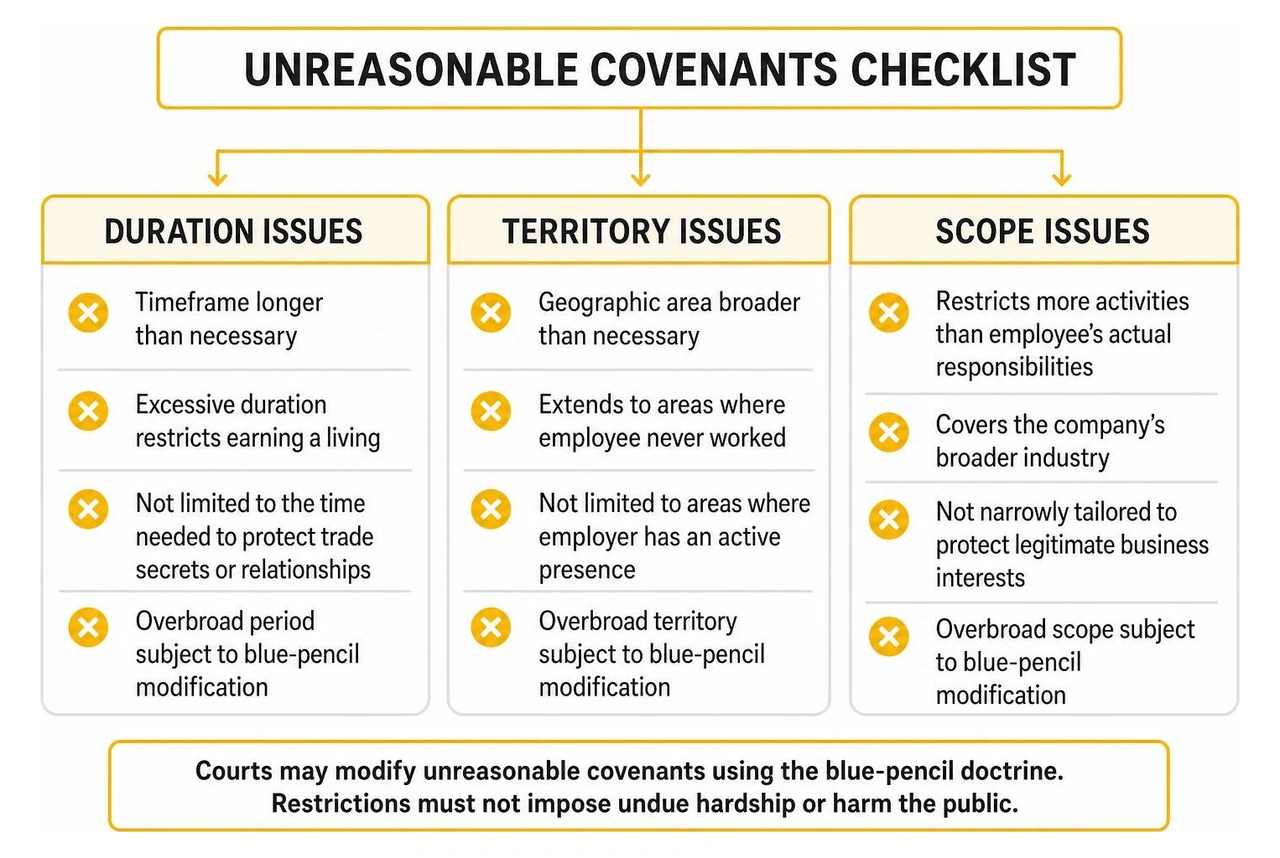
- Duration: Is the restricted timeframe no longer than necessary to protect trade secrets or customer relationships?
- Geographic Limits: Is the geographic boundary restricted strictly to areas where the employer maintains an active presence and where the employee established client goodwill?
- Scope of Business: Are the restricted activities narrowly tailored to the worker's actual responsibilities rather than the company's broader industry?
Under established principles of covenant not to compete enforcement, judges in Michigan also utilize the "blue-pencil" doctrine. This gives a court the equitable power to modify an unreasonable agreement by reducing an excessive geographic radius or cutting down an overbroad duration to make it enforceable, rather than striking down the contract entirely.
When Courts Strike Down an Unreasonable Non-Compete Agreement
A court will invalidate a covenant if it imposes an undue hardship on the employee or harms the general public. Agreements are routinely struck down when:
- The restriction prevents a worker from earning a living in their trained field.
- The geography extends to territories where the employee never worked.
- The employer lacks a protectable business interest and simply aims to eliminate lawful competition.
- The restraint interferes with public policy, such as restricting access to medical care.
Consideration and Garden Leave Protections
A valid covenant requires adequate legal consideration. While new employment provides sufficient consideration for a new hire, existing staff asked to sign an agreement mid-tenure must receive meaningful value, such as a wage increase, equity grant, or specialized training.
Some states have codified enhanced financial protections. For example, under Massachusetts General Law Chapter 149 Section 24L, non-compete agreements must include a "garden leave" clause or mutually agreed-upon consideration. This requires the employer to pay at least 50 percent of the employee's highest annualized base salary over the prior two years on a pro-rata basis throughout the entire restricted period.
State and Federal Legal Landscape in 2026

The legal landscape surrounding workplace mobility has changed dramatically in recent years. In 2024, the Federal Trade Commission proposed a comprehensive nationwide ban on non-compete clauses. While this regulatory effort has faced extensive federal court challenges, it accelerated state-level reforms across the country.
For professionals navigating contracts in Michigan, staying current on Michigan non-compete legal standards is essential to protecting your career mobility and avoiding unexpected disputes.
Total Ban States vs. Reasonableness Jurisdictions
Across the United States, covenant enforcement falls into two distinct philosophies:
- Prohibition Jurisdictions: California (under Business and Professions Code Section 16600), Oklahoma (15 O.S. Section 219A), and North Dakota (Century Code Section 9-08-06) maintain near-total bans on employee non-competes. In these states, restrictive covenants are void against public policy, with narrow exceptions reserved for equity sales. Understanding how covenants during business acquisitions operate is important, as courts consistently permit restrictive covenants when purchasing a company's goodwill.
- Statutory Reasonableness Jurisdictions: States like Florida provide structured statutory frameworks. Under Florida Statute Section 542.335, restrictive covenants of six months or less are presumed reasonable, while those exceeding two years carry a statutory presumption of unreasonableness that the employer must rebut.
State-Specific Reforms: Colorado, Massachusetts, and Michigan
State legislatures have passed targeted laws to limit workplace covenants and protect worker mobility:
- Colorado: The Colorado Chance to Compete Act created strict requirements for employers. The law introduced an administrative penalty structure where the Division of Labor Standards and Statistics issues a warning order for a first violation requiring compliance within 30 days, fines up to $1,000 for a second violation, and penalties up to $2,500 for third or subsequent violations. The Act also requires employers to preserve written or electronic employment applications that include criminal history inquiries for 18 months or through any active investigation.
- Massachusetts: The Massachusetts Noncompetition Agreement Act limits post-employment restrictions to a maximum of 12 months (extendable to 24 months only if the worker breached a fiduciary duty or unlawfully took company property), while expressly exempting nonexempt hourly workers, students, and employees terminated without cause.
- Michigan: Michigan courts evaluate covenants under a structured reasonableness test. Obtaining guidance from a Michigan non-compete lawyer helps ensure that employees and executives can address ambiguous contract terms before accepting a new role. This review is particularly important in specialized industries, as seen in the enforceability rules governing physician covenants where patient care and public access to medicine create distinct legal standards.
Breach of Covenant: Remedies, Penalties, and Dispute Resolution
If an employer believes an employee has violated an enforceable covenant, the company can pursue several legal remedies:
- Temporary Restraining Orders (TRO) and Preliminary Injunctions: Rapid emergency motions designed to immediately halt competitive employment or client solicitation before a full trial takes place.
- Actual Compensatory Damages: Financial compensation reflecting provable lost profits, lost business opportunities, or client account transitions.
- Liquidated Damages: Contractually agreed-upon financial penalties, which courts will enforce only if they reflect a reasonable estimate of anticipated damages rather than an arbitrary punitive fine.
- Tolling Provisions: Clauses that extend the restricted period day-for-day for the duration of any proven breach.
- Attorneys' Fees and Costs: Contractual provisions requiring the breaching party to pay the other party's legal expenses.
If you are facing an active dispute or reviewing an exit package, consulting a severance and employment agreement lawyer ensures your rights and career options remain protected.
Frequently Asked Questions About Restrictive Employment Covenants
What Voids an Employment Restraint?
An agreement becomes void if it lacks valid consideration, restricts an unreasonably broad geographic footprint, or exceeds a necessary duration. Covenants that harm the public interest or attempt to restrict low-wage, non-exempt workers are also routinely struck down.
Can an Employer Enforce Covenants After Involuntary Termination?
In many jurisdictions, if an employee is laid off or discharged without cause, courts may refuse to enforce non-compete covenants on equitable grounds. When an employer ends the employment relationship without misconduct by the worker, judges often find it unfair to prevent that individual from earning a living.
How Do Courts Handle Remote and Multi-State Workers?
Remote work arrangements complicate traditional geographic boundaries. Courts look at the employee's material presence, where the services were actually performed, and choice-of-law provisions in the contract. A restriction designed for a traditional office setting cannot be expanded to an unconstrained nationwide ban simply because a company conducts general business online.
Conclusion
A restrictive covenant should never be treated as standard, harmless paperwork. Signing an overbroad contract can limit your career mobility, delay new job opportunities, and lead to expensive litigation.
Before signing a new agreement or assuming an old covenant prevents you from accepting an offer, review your options. For dedicated legal guidance, consider partnering with a non-compete attorney in Southfield, MI at Scott Batey Law to review your agreements and safeguard your future.