.png)
Understanding the 30-Minute Lunch Break Law and Your Right to Eat in Peace

What the 30-Minute Lunch Break Law Really Requires
The 30-minute lunch break law is not a single federal rule. Federal law does not require employers to provide lunch breaks at all. Instead, your right to a meal break usually depends on the state where you work, your age, your industry, and sometimes a union contract.
| Quick answer | Rule |
|---|---|
| Does federal law require a 30-minute lunch? | No. The Fair Labor Standards Act does not require meal or coffee breaks. |
| Is a 30-minute lunch usually paid? | Not if you are fully relieved from work. If you must work, monitor messages, answer calls, or stay on duty, it may need to be paid. |
| Does Michigan require adult lunch breaks? | Generally, no. Michigan does require meal and rest protections for many workers under 18. |
| Can state law provide more protection? | Yes. States such as California, Minnesota, and New York have meal-break rules for many adult employees. |
A lunch break should mean time to eat without being expected to keep working. If your employer automatically deducts 30 minutes from your pay while you answer phones, watch equipment, respond to messages, or remain responsible for customers, that deduction may be a wage-and-hour problem.
I am Scott Batey, a Michigan employment lawyer who has represented workers since 1996 in workplace disputes involving retaliation, discrimination, wrongful termination, and pay-related concerns. Understanding the 30-minute lunch break law can help you spot whether a missed or interrupted break is simply an unfair workplace practice or a violation of a legal right.

Terms related to 30-minute lunch break law:
- employee break laws in michigan
- employment law breaks at work
- how many breaks in a 12-hour shift by law
Federal vs. State 30-Minute Lunch Break Law Standards
Navigating wage and hour compliance can be confusing because federal standards set a baseline, while individual states often build more detailed worker protections on top of that foundation. When workers ask us whether they have a legal entitlement to step away from their desks or job sites for mid-day sustenance, we have to start by distinguishing between what the federal government requires and what state labor statutes dictate.
Under the Fair Labor Standards Act (FLSA), federal legislation focuses primarily on minimum wage, overtime pay, and child labor standards. It leaves the decision of whether to grant meal periods or rest breaks entirely to individual employers or state regulations. For comprehensive national oversight details, review the U.S. Department of Labor Meal Break Guidelines. For an in-depth look at how workplace breaks intersect with general wage rights, explore our guide on Employment Law Breaks at Work.
Is a 30-Minute Lunch Break Required by Federal Law?
The short answer is no. Ever since the FLSA was enacted in 1938, federal law has not mandated that employers grant lunch breaks or rest periods to adult employees. Whether you work an eight-hour day or a grueling twelve-hour shift, federal statute does not force your employer to give you time off to eat.
However, federal regulations strictly govern how break time must be compensated if an employer chooses to offer it:
- Short Rest Periods (5 to 20 Minutes): Federal rules classify short rest periods—typically lasting between 5 and 20 minutes—as compensable work time. Because these short pauses are recognized as benefiting the employer by promoting efficiency and reducing fatigue, they must be included in total hours worked and factored into overtime calculations. If you're wondering about shorter rest periods in local workplaces, see our analysis on Are 15-Minute Breaks Required by Law in Michigan?.
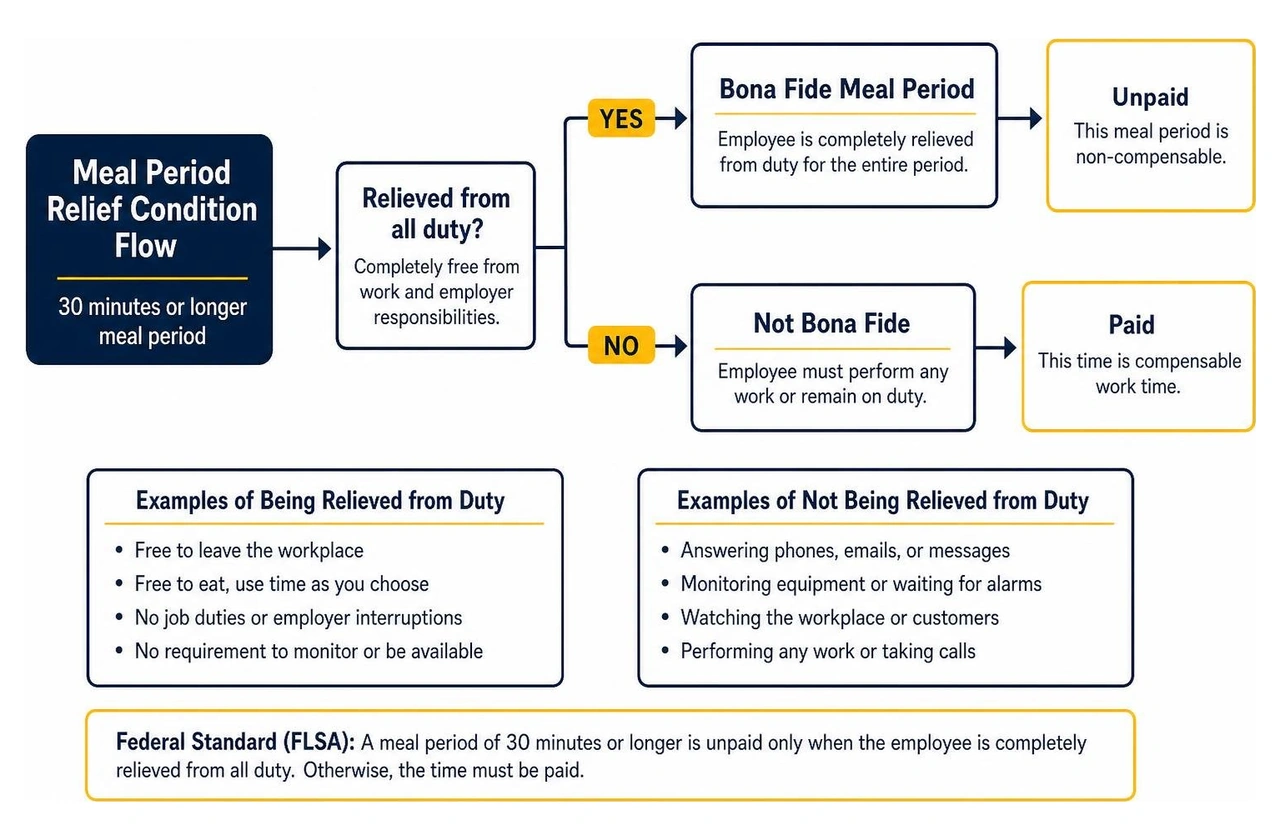
- Bona Fide Meal Periods (30 Minutes or Longer): Federal law defines a bona fide meal period as a break that typically lasts at least 30 uninterrupted minutes. These meal breaks are non-compensable (unpaid), provided the employee is completely relieved from all duty. If an employer requires a worker to perform active or passive tasks during lunch—such as standing by for phone calls, watching a machine, or waiting for deliveries—the meal break is not bona fide and must be fully paid.
Key Provisions of the 30-Minute Lunch Break Law for Adult Employees
Because the FLSA remains silent on mandatory break times, state law serves as the primary battleground for meal break enforcement. Roughly 21 states and territories across the nation have enacted statutes requiring meal breaks for adult private-sector employees.
These state laws vary widely regarding shift length triggers, mandatory duration, timing during the shift, and waiver rules:
- State Shift Triggers: States with meal mandates typically require a mandatory 30-minute meal break once an employee works a continuous block of 5 or 6 hours.
- Adult Private-Sector Coverage: In states with adult break statutes, coverage generally applies across most private-sector industries, though specialized carve-outs exist for healthcare, security, agriculture, and unionized workforces.
- States Without Adult Break Requirements: In many states, including Michigan, state law does not require employers to provide meal breaks or coffee breaks to adult employees aged 18 and older. Employers in these states can set their own break policies, provided they properly compensate any short rest periods or working meal times under federal standards. To understand state-specific nuances, consult an Overview of State Meal Period Laws and read our breakdown of Employee Break Laws in Michigan.
State Breakdown: Meal Break Rules in California, Minnesota, and New York
To see how state statutes alter workplace rights, let's examine three states that enforce detailed meal break requirements for adult workers: California, Minnesota, and New York.
| State | Statutory Shift Threshold | Mandatory Break Duration | Pay Requirement | Non-Compliance Penalties |
|---|---|---|---|---|
| California | Over 5 hours (1st break) Over 10 hours (2nd break) | 30 minutes uninterrupted | Unpaid if fully duty-free | 1 hour of regular pay per daily violation |
| Minnesota | 6 or more consecutive hours (Effective Jan 1, 2026) | 30 minutes uninterrupted | Unpaid if fully duty-free | Double pay for missed break time |
| New York | Over 6 hours (Most industries) | 30 minutes (1 hour for factory workers) | Unpaid if fully duty-free | State administrative fines & back wage assessments |
California Meal Break Mandates and Shift Thresholds
California maintains some of the most stringent labor protections in the country. Under state labor rules, non-exempt employees working more than 5 hours per day are entitled to an uninterrupted, duty-free 30-minute meal break. This break must start before the end of the employee's fifth hour of work.
If a shift exceeds 10 hours, the employer must provide a second 30-minute meal period. As outlined in the California Labor Code Section 512 Statute, if an employer fails to provide a compliant meal break, they must pay the employee a statutory penalty of one additional hour of pay at the worker's regular rate of compensation for each workday that the meal period was denied.
Minnesota and New York Meal Break Regulations
Other state jurisdictions have also enacted robust statutory protections:
- Minnesota 2026 Statutory Updates: Under Minnesota's updated labor laws, effective January 1, 2026, employers must provide a 30-minute meal break whenever an employee works six or more consecutive hours. The break may only be unpaid if the worker is completely relieved of all duties. Employers who fail to grant required breaks face strict monetary remedies, including owing employees double the amount of pay that would have been earned during the missed break.
- New York Shift Requirements: New York State law requires employers to provide at least 30 minutes of unpaid meal time for employees working a shift longer than 6 hours. For factory workers, New York mandates a full 60-minute meal period at noon unless a special permit for a shorter duration is granted by the state labor department.
For a comprehensive multi-state analysis, contractors and employers can consult the State Lunch Break Laws Compliance Guide.
When Must a Lunch Break Be Paid vs. Unpaid?
A central point of friction between employers and staff is determining whether a 30-minute break must be compensated. Under both federal FLSA standards and state rules, the dividing line rests on whether the worker experiences complete duty relief.
Off-Duty vs. On-Duty Meal Periods
To qualify as an unpaid, bona fide meal period, an employee must be completely relieved of all job duties, active or passive. If an employee is required to remain at their desk, handle customer inquiries, answer incoming calls, watch safety monitors, or respond to radio dispatches while eating, they are legally "on duty."
Federal courts apply strict legal standards when evaluating meal break disputes:
- The Predominant Benefit Test: Most federal circuits evaluate whether the break time is spent predominantly for the benefit of the employer or the employee. If job responsibilities interrupt the break or force the worker to remain focused on work tasks, the period predominantly benefits the employer and must be paid.
- The Complete Relief Standard: In stricter jurisdictions (such as the Ninth Circuit), any requirement that prevents complete operational freedom renders the meal period compensable.
- Desk Lunches and Remote Workers: Sitting at a workstation or remaining logged into queue monitoring systems during lunch transforms a break into compensable work time. For detailed pay guidelines, view our resource on Paid Breaks for Hourly Employees.
Waiving a 30-Minute Lunch Break Law Requirement
Can an employee choose to waive their lunch break to leave work early? In jurisdictions where meal breaks are mandated by statute, waivers are tightly controlled to prevent employer coercion:
- Shift Length Limits: In states like California, a 30-minute meal break for a shift over 5 hours can only be waived by mutual consent if the total work period for the day does not exceed 6 hours.
- Second Break Waivers: For long shifts exceeding 10 hours, a second 30-minute meal break may be waived only if the total hours worked do not exceed 12 hours and the first meal break was taken properly.
- Voluntary Consent: Any waiver must be entirely voluntary. Employers cannot threaten, force, or retaliate against workers who refuse to waive their statutory break rights.
Special Protections, Waivers, Penalties, and CBA Exceptions
While general rules apply to typical office and industrial workplaces, specialized provisions exist for underage workers, specific high-intensity industries, and unionized facilities.
Meal Break Regulations for Minors and Specific Industries
Youth labor laws almost universally enforce mandatory rest and meal breaks, even in states that offer no statutory break rights to adults:
- Minor Worker Protections: In Michigan and Wisconsin, for example, state law requires employers to provide a 30-minute duty-free meal break to minor workers (under age 18) for continuous shifts exceeding 5 or 6 hours.
- Healthcare and Emergency Services: In hospitals and acute care facilities, specialized on-duty meal agreements permit continuous coverage provided staff are fully compensated and allowed to eat on site.
- Construction, Commercial Driving, and Security: Continuous operations in heavy construction (such as concrete pouring), long-haul logistics, and building security often utilize statutory carve-outs or federal DOT rest rules rather than standard state meal mandates. Learn more about long shift break structures in our article How Many Breaks in a 12-Hour Shift by Law.
For official state administrative positions, refer to the Michigan Rest and Meal Period Guidelines.
Collective Bargaining Agreements and Statutory Penalties
Unionized workplaces operate under collective bargaining agreements (CBAs) that can customize break policies:
- CBA Overrides: In many states, valid collective bargaining agreements can modify or waive statutory meal break rules, provided the union contract outlines clear break parameters, premium pay rates, and binding arbitration procedures.
- Statute of Limitations: Under the FLSA, employees claiming back pay for unpaid, working meal periods face a two-year statute of limitations for standard wage claims, which extends to three years if the employer's violation was willful.
- Liquidated Damages: Successful FLSA unpaid wage claims allow workers to recover back pay plus an equal amount in statutory liquidated damages, effectively doubling their financial recovery.
Frequently Asked Questions About Meal Break Regulations
Here are common legal questions workers and employers ask regarding 30-minute lunch break law compliance and workplace rights.
What should I do if my employer routinely denies my meal break?
If your employer routinely denies required meal breaks or forces you to work through unpaid lunch periods, take these practical steps:
- Keep a Personal Log: Maintain a detailed daily record on a personal device or notebook documenting your start times, stop times, exact break durations, and any work tasks performed during lunch.
- Preserve Digital Evidence: Save emails, text messages, chat queue logs, pay stubs, and badge swipe records that prove you were working during uncompensated meal periods.
- Review Company Policies: Check your employee handbook to verify whether your employer maintains a formal process for reporting interrupted or worked-through lunches.
- Consult an Employment Lawyer: Contact an experienced wage attorney to evaluate your claim and assist you in filing a formal wage complaint with the U.S. Department of Labor Wage and Hour Division or state enforcement agencies.
Are automatic payroll deductions for lunch breaks legal?
Automatic payroll deductions—where an employer's timekeeping software automatically subtracts 30 minutes from your daily timecard for a lunch break—are legally permissible only if you actually receive a full, uninterrupted 30-minute duty-free meal period.
If an employer automatically deducts 30 minutes while knowing or having reason to know that you worked through lunch, the employer has committed a wage theft violation. Employers who utilize automatic deductions must provide an accessible, hassle-free procedure for employees to report worked-through breaks so that the time can be added back to their paycheck.
Do remote employees have the same meal break rights as on-site workers?
Yes. Remote, work-from-home, and hybrid workers are covered by the exact same federal FLSA and state wage laws as on-site personnel.
If a remote employee is subject to state meal break mandates or is subjected to automatic 30-minute payroll deductions, they must be fully relieved of all duties during that break. Employers cannot track mouse movements, require continuous status availability, or demand quick replies on team chat channels while a remote worker is supposedly on an unpaid 30-minute meal break.
Conclusion

While the 30-minute lunch break law is not mandated at the federal level, meal break rights are enforced through state statutes, youth labor provisions, and strict federal pay rules governing short rest periods and on-duty meal time. If your employer automatically deducts lunch time while expecting you to stay on duty, answer messages, or remain at your post, you may be entitled to significant unpaid back wages and liquidated damages.
At Scott Batey Law, we have spent over 25 years advocating for workers across Metro Detroit, including Bingham Farms, Southfield, Troy, Detroit, and Oakland County. If you believe your wage rights have been violated or face workplace retaliation for raising pay concerns, turn to an Experienced Wage & Overtime Lawyer in Metro Detroit to protect your rights and recover the compensation you deserve.