.png)
How to Build a Strong Lawsuit After Being Wrongfully Fired

How to Build a Strong Wrongful Termination Case
Think you were fired illegally? Save your termination notice, performance reviews, complaints, and relevant messages. Write down a timeline while the details are fresh. Then speak with an employment lawyer promptly: the right filing deadline and agency depend on why you were fired.
Michigan employers can generally fire at-will employees, but not for an unlawful reason, such as discrimination or retaliation for reporting harassment. A broken company policy may also matter, especially if it helps show the employer's stated reason was not the real one.
I'm Scott Batey, a Michigan employment lawyer who has represented workers in wrongful termination and retaliation disputes since 1996. I help employees assess whether a lawsuit for being wrongfully fired is supported by the facts and what steps could protect their rights.
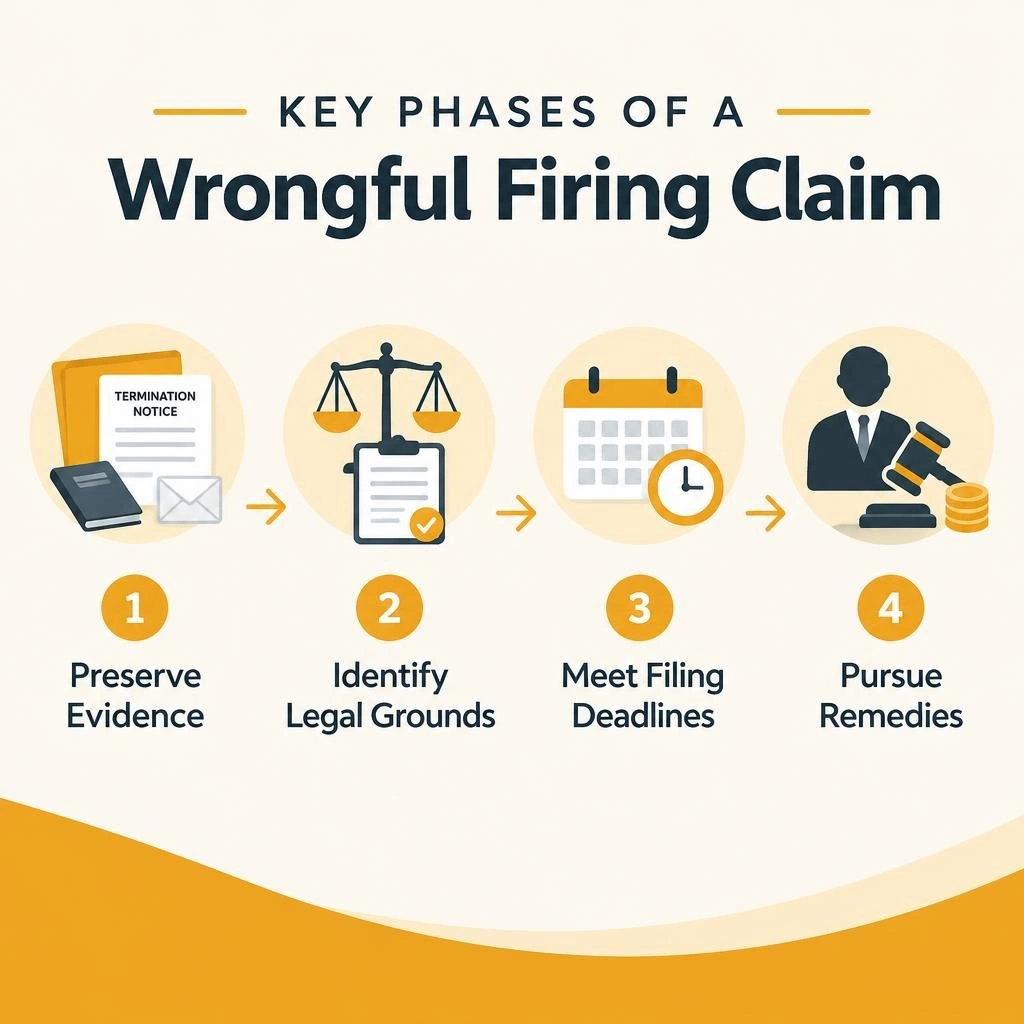
Lawsuit for being wrongfully fired further reading:
- attorney for wrongfully fired
- being wrongfully terminated from job
- i feel i was wrongfully terminated from my job
Grounds for Filing a Lawsuit for Being Wrongfully Fired
Understanding the boundary between an unfair firing and an illegal firing is the cornerstone of any employment claim. In Michigan, the default legal rule is at-will employment. This means that an employer can terminate an employee for a good reason, a poor reason, or no reason at all, without incurring legal liability. However, "at-will" does not mean "free-for-all."
An employer cannot discharge a worker for an illegal motive. When a dismissal breaches specific federal statutes, state laws, public policy, or contractual obligations, it crosses the line into wrongful discharge. Understanding the fundamental at-will employment exceptions in Michigan helps workers determine whether their rights were violated.
| Termination Category | Legal Justification / Examples | Lawful or Unlawful? | Applicable Legal Standards |
|---|---|---|---|
| Standard At-Will Firing | Personality clash, corporate restructuring, minor performance issues, general downsizing. | Lawful | At-will employment doctrine |
| Statutory Discrimination | Firing based on race, sex, age, disability, religion, pregnancy, or national origin. | Unlawful | Title VII, ADA, ADEA, ELCRA |
| Protected Activity Retaliation | Firing for reporting safety hazards, wage theft, illegal acts, or harassment. | Unlawful | OSHA, SEC, Michigan WPA, FLSA |
| Public Policy Violation | Firing for refusing to break the law or exercising a statutory right (e.g., filing workers' comp). | Unlawful | Michigan Public Policy Doctrine |
| Breach of Contract | Terminating an employee without cause when a written or implied "just cause" contract exists. | Unlawful | Michigan Contract Law |
Whistleblowing and Protected Activity Retaliation
Federal and state statutes provide explicit safeguards for workers who act as watchdogs within their organizations. Under federal frameworks like the Occupational Safety and Health Act (OSHA), workers cannot be fired for reporting hazardous workplace environments or safety compliance failures. Similarly, reporting corporate financial misconduct under the Securities and Exchange Commission (SEC) whistleblower rules protects individuals from retaliatory dismissal.
In Michigan, the Whistleblowers' Protection Act (WPA) shields employees who report or are about to report a suspected violation of federal, state, or local law to a public body. When a company retaliates against an employee for blowing the whistle on illegal corporate operations, the worker can pursue substantial remedies. Experiencing retaliation after reporting harassment or safety abuses represents one of the clearest grounds for legal action.
Medical Leave, Disability, and Caregiver Bias
Employees are frequently targeted when they require time off for serious health conditions or family caregiving. The Family and Medical Leave Act (FMLA) grants eligible employees up to 12 weeks of unpaid, job-protected leave. Employers often attempt to circumvent these protections through subtle interference or by disciplining returning workers under the guise of performance issues.
Simultaneously, the Americans with Disabilities Act (ADA) requires employers to offer reasonable accommodations to employees with qualifying disabilities, provided the accommodation does not create an undue hardship. Legal complexities frequently arise in FMLA and ADA claim overlaps, where a medical leave request triggers a retaliatory discharge.
Courts carefully examine the tension between employer performance standards and protected leave. For instance, in the federal court opinion for Sparks v. The New York Times Company, 1:24-cv-00455, the court evaluated whether an employer used a Performance Improvement Plan (PIP) as an FMLA retaliation mechanism following parental leave. These cases demonstrate that while employers often cite legitimate business justifications, timing and documentation reveal whether an adverse action was genuinely based on performance or rooted in caregiver bias and protected leave discrimination.
Procedural Steps and Administrative Filings

Taking on an employer requires navigating strict procedural steps before stepping foot inside a courtroom. When an employer creates intolerable working conditions rather than firing someone outright, the law may still treat the situation as a formal termination under constructive discharge legal standards. In either scenario, administrative rules dictate the process.
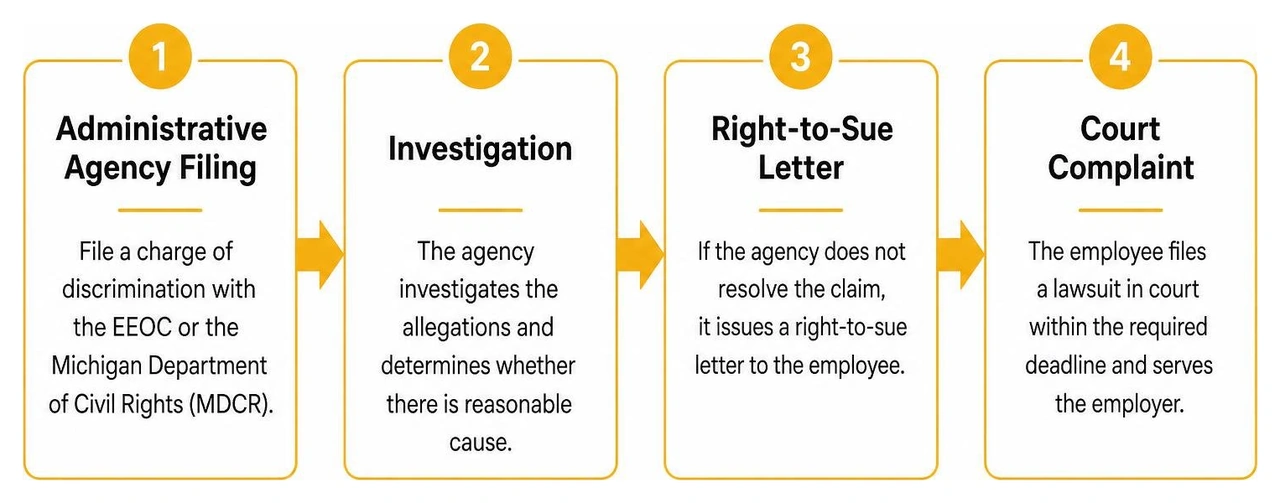
When to File an Administrative Complaint Before a Lawsuit for Being Wrongfully Fired
For most federal discrimination and retaliation claims, an employee cannot immediately file a civil lawsuit. Instead, they must first satisfy the doctrine of "administrative exhaustion" by lodging a formal charge of discrimination with the Equal Employment Opportunity Commission (EEOC) or the Michigan Department of Civil Rights (MDCR).
The administrative process adheres to strict timelines:
- EEOC Charge Filing: Under federal law, you generally have 180 calendar days from the date of the unlawful act to file a charge. In deferral states like Michigan, where state agencies enforce complementary civil rights laws, that window extends to 300 days.
- OSHA Whistleblower Complaints: Workplace safety retaliation complaints must be filed with OSHA within 30 days of the retaliatory action.
- NLRB Unfair Labor Practice: Claims involving interference with protected concerted activity must be brought before the National Labor Relations Board (NLRB) within six months.
- Right-to-Sue Notice: Once the EEOC completes its investigation or dismisses the charge, it issues a "Notice of Right to Sue." From the day you receive that notice, you have exactly 90 days to initiate a lawsuit in court.
Missing any of these administrative windows can permanently bar your claim. Following a comprehensive wrongful termination legal roadmap ensures every prerequisite is satisfied on time.
Federal Employees vs Private Sector: The MSPB and CSRA
Federal civil service personnel operate under a distinct legal structure governed by the Civil Service Reform Act (CSRA) of 1978. While private-sector employees rely on standard state and federal civil courts, non-probationary federal workers generally appeal major adverse employment actions—such as removals, suspensions exceeding 14 days, or grade reductions—to the Merit Systems Protection Board (MSPB).
Under the established Thunder Basin doctrine, Congress intended the CSRA to be the exclusive administrative avenue for federal personnel disputes, which typically divests federal district courts of direct jurisdiction. However, high-profile jurisdictional questions arise when a federal firing falls outside typical civil service reviews.
In the landmark Southern District of New York ruling in the case of Maurene Comey v. Department of Justice, the federal court analyzed whether an Assistant U.S. Attorney removed under asserted Article II presidential authority could bypass the MSPB scheme and challenge her termination directly in federal district court. This highlights the critical distinction between private-sector tort litigation and federal civil service administrative law.
How Courts Evaluate Evidence and Pretext in Wrongful Discharge
When an employment lawsuit reaches court, judges and juries evaluate the dispute using established burden-shifting frameworks. Because direct evidence—such as an email explicitly stating "we are firing you because of your age"—is rare, plaintiffs primarily prove their cases using circumstantial evidence under the three-part McDonnell Douglas standard:
- Prima Facie Case: The employee demonstrates they belong to a protected class, performed their job satisfactorily, suffered an adverse employment action, and experienced treatment disparate from similarly situated coworkers outside the protected class.
- Employer's Non-Discriminatory Reason: The employer presents a legitimate, business-related reason for the discharge (e.g., poor metrics or corporate restructuring).
- Pretext: The burden shifts back to the employee to prove that the employer's stated reason is a fabrication, cover-up, or pretext designed to conceal unlawful discrimination or retaliation.
Judicial analysis often explores overall workplace culture and management remarks. In the notable Seventh Circuit decision in Debra Pratt v. Wisconsin Aluminum Foundry, the appellate court reversed a lower court's summary judgment. The appellate panel determined that lower courts must examine the totality of the evidence—including discriminatory remarks by managers, inconsistent performance ratings, and systemic corporate culture—to let juries decide if stated firing justifications are fraudulent. Understanding these dynamics is central to proving pretext in employment lawsuits.
Gathering Evidence to Support a Lawsuit for Being Wrongfully Fired
To establish pretext, concrete evidence must be collected and organized methodically. Workers can build a foundation for their claims by focusing on several evidentiary pillars:
- Contemporaneous Documentation: Detailed, dated personal notes written immediately after meetings, disciplinary sessions, or discriminatory events.
- Comparative Treatment Evidence: Proof showing that colleagues outside your protected class engaged in similar conduct or exhibited identical performance metrics but were retained, promoted, or granted leniency.
- Positive Historical Records: Prior performance evaluations, written commendations, bonus payouts, and client praise that contradict sudden claims of incompetence.
- Temporal Proximity: A tight timeline between engaging in a protected activity (such as requesting leave or complaining about harassment) and an adverse employment action provides strong circumstantial proof of retaliatory intent.
Developing a strategic approach involves building an evidence timeline after firing and proving timing pretext through temporal proximity to dismantle the employer's defense.
Employer Policy Violations and Pretextual PIPs
Company handbooks frequently establish progressive discipline procedures—such as requiring a verbal warning, written reprimand, and Performance Improvement Plan (PIP) prior to discharge. When an employer suddenly bypasses its established progressive discipline model, that departure serves as evidence of pretext.
Similarly, employers often implement sham PIPs with unattainable metrics or vague standards designed to create a paper trail for a predetermined termination. In other instances, organizations engineer "restructurings" or "job eliminations" that only eliminate targeted whistleblowers. When these tactics arise alongside exit packages, conducting a thorough severance agreement review is critical before waiving underlying legal claims.
Remedies, Damages, and Compensation Structures
A successful wrongful termination lawsuit aims to make the wronged employee whole. Depending on the applicable statutes and the specific facts of the case, available financial and equitable remedies include:
- Back Pay: Total compensation lost from the date of the unlawful termination up to the date of settlement or trial judgment, including base salary, overtime, bonuses, accrued vacation pay, and the monetary value of lost health insurance.
- Front Pay: Projected future earnings awarded when job reinstatement is impossible due to workplace hostility or damaged working relationships.
- Compensatory Damages: Compensation for emotional distress, psychological trauma, depression, reputational harm, and loss of professional standing.
- Punitive Damages: Financial penalties awarded under federal civil rights statutes (subject to statutory damage caps based on company size) to punish employers who acted with malice or reckless indifference.
- Reinstatement: A court order directing the employer to restore the worker to their former position or an equivalent role.
- Attorney's Fees and Litigation Costs: Statutory provisions enabling prevailing employees to have their legal representation expenses paid by the defendant employer.
Pursuing these remedies requires an in-depth understanding of how wrongful discharge claims in Michigan are litigated across local courts.
Frequently Asked Questions About Wrongful Termination Claims
How long do I have to file a wrongful termination claim?
Statutes of limitations vary widely depending on the legal basis of your claim. In Michigan:
- EEOC/MDCR Discrimination Claims: You have 300 days from the date of the unlawful employment action to file an administrative charge.
- Elliott-Larsen Civil Rights Act (ELCRA): State-level statutory claims generally have a 3-year statute of limitations.
- Whistleblowers' Protection Act (WPA): Michigan's WPA has an extremely strict 90-day deadline from the date of the retaliatory act.
- FMLA Violations: Standard claims must be filed within two years, extending to three years for willful employer violations.
Because deadlines range from 30 days to three years, speaking with an employment attorney immediately is vital to avoid forfeiting your right to recover damages.
Can I sue if my employer violated their own progressive discipline policy?
Under standard at-will rules, general employer policies do not automatically create binding contracts. However, an employer's policy violation can support a lawsuit in two distinct ways:
- Implied Contract Claims: If the employee handbook contains clear, explicit language stating an employee will only be discharged for "just cause" or upon completion of specific disciplinary steps—and lacks a clear at-will disclaimer—it may create an enforceable implied contract under Michigan law (Toussaint v. Blue Cross & Blue Shield of Michigan).
- Evidence of Pretext: Even in pure at-will scenarios, an employer's uncharacteristic failure to follow its own disciplinary procedures when firing a protected employee provides valuable circumstantial evidence that the stated rationale is pretextual.
What can I do if I was fired for political speech or family connections?
In the private sector, the First Amendment does not protect employees from being discharged by private companies for expressing personal or political viewpoints. However, legal protections may still apply depending on jurisdiction and context.
For example, in high-profile entertainment disputes involving wrongful termination and political speech retaliation claims against major studios, plaintiffs have leveraged unique state labor codes (such as California Labor Code §§ 1101–1102) that prohibit employers from attempting to control employees' political activities.
For public-sector employees, government employers are constrained by the First and Fourteenth Amendments. As demonstrated in regional municipal rulings, such as public reporting where a judge ruled the City of Troy unlawfully fired a volunteer firefighter for running for public office, government entities cannot discipline workers for engaging in constitutionally protected civic activity.
Additionally, if a discharge involves family connections or political associations that intersect with marital status discrimination or civil service protections, distinct statutory protections apply.
Conclusion
Building a successful wrongful discharge lawsuit requires prompt evidence preservation, strict adherence to administrative filing deadlines, and a proven method for demonstrating employer pretext. At Scott Batey Law, our team brings over 25 years of courtroom experience advocating for workers across Bingham Farms, Birmingham, Southfield, Troy, Royal Oak, and Oakland County, MI.
If you believe your termination breached state or federal law, take immediate steps to safeguard your rights. Contact us today for a strategic evaluation with an experienced wrongful termination attorney in Birmingham, MI.